The Galaxian-Donkey Kong Connection#
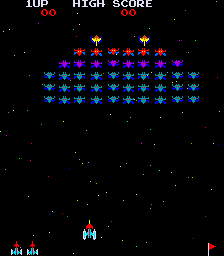
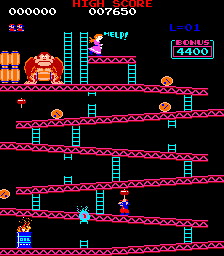
For my book, Making 8-bit Arcade Games in C, I had to research the hardware of various arcade game systems. Galaxian was one of the first games to feature multicolor sprites, which is why it’s one of the five platforms included in the book.[1]
While researching Galaxian, I stumbled upon a website describing how to hack the graphic ROMs in Donkey Kong to turn Mario into Pauline. Reading it, I noticed something curious – Donkey Kong’s internal graphics format is surprisingly similar to Galaxian’s. Not only does the background tilemap have the same dimensions and colors, but the 16x16 sprites are laid out the same way in memory, each 4-byte record having the same fields in the same order:[2]
Offset |
Value |
|---|---|
0 |
Horizontal Position |
1 |
Sprite Pattern |
2 |
Sprite Attribute |
3 |
Vertical Position |
There are minor differences, like which bytes have the X and Y sprite flip bits, but otherwise the layout is the same.
Radar Scope#
|
|
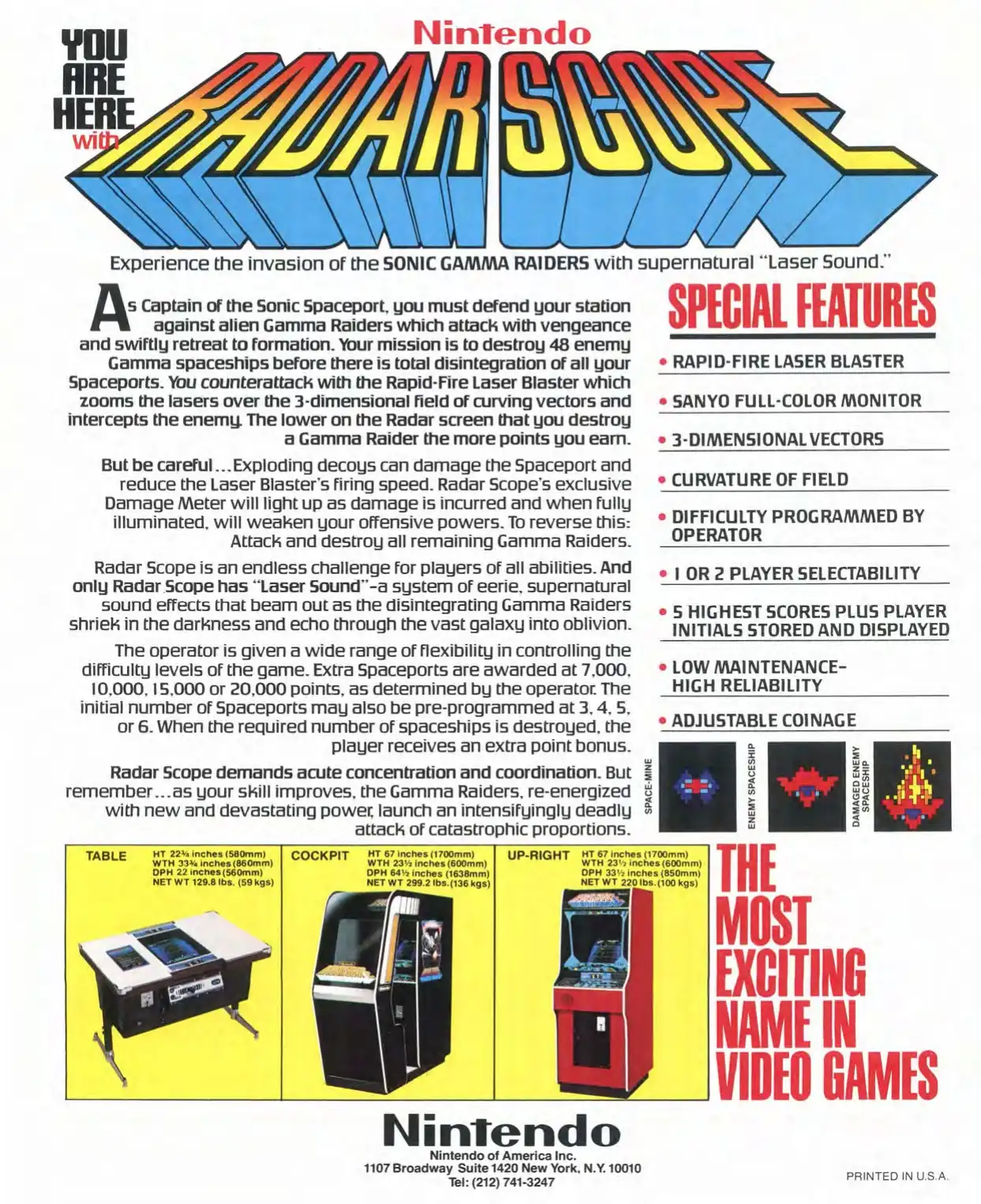
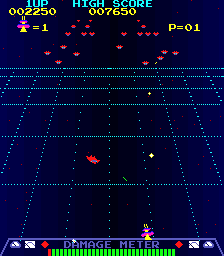
Poking around the MAME source, I discovered that Donkey Kong’s video hardware was more advanced than Galaxian’s. Galaxian only supported 8 sprites, but Donkey Kong used a wholly different technique that could support 128 sprites in a single frame (16 on a single scanline).[3]
Did Donkey Kong need all 128 sprites? Not really. But Donkey Kong’s predecessor was Nintendo’s Radar Scope, which had dozens of enemies attacking the player in a pseudo-3D formation, sort of a flat version of Gyruss. It was intended as a high-tech response to the Space Invaders craze, but the market for arcade space shooters had become oversaturated.[4]
The story goes: Radar Scope didn’t sell well in the U.S., so Nintendo internally solicited ideas for a new game that could use the same hardware. An idea from young designer Shigeru Miyamoto was chosen, and Donkey Kong was born. The game was then programmed into unsold Radar Scope games in the U.S. warehouse (whose landlord, Mario, had been eagerly awaiting the next rent payment).
So Donkey Kong’s hardware is really Radar Scope’s. Who built it, and why does it look so much like Galaxian’s?
Enter Ikegami Tsushinki#
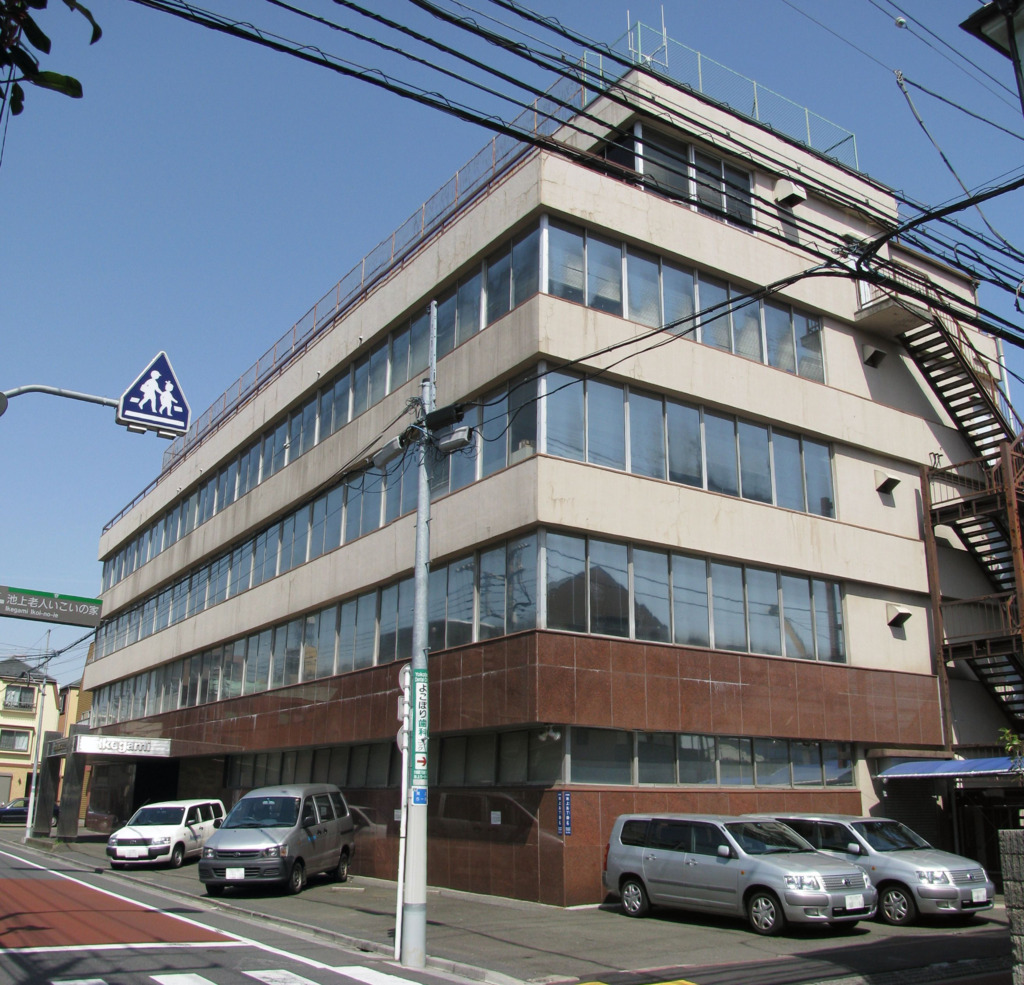
Ikegami Tsushinki headquarters#
Nintendo’s engineers could specify an arcade machine, but they didn’t build one themselves. For that they used a contractor, Ikegami Tsushinki Co., Ltd., a maker of broadcast TV cameras that did the heavy lifting on several Nintendo arcade games, up to and including Donkey Kong. On Radar Scope, according to project lead (and future Famicom architect) Masayuki Uemura, Nintendo wrote the requirements and Ikegami designed the circuits. Donkey Kong reused the Radar Scope board, so Ikegami’s job there was the program, with guidance from Miyamoto and longtime Nintendo designer Gunpei Yokoi.
Just how much of Donkey Kong was Ikegami’s later became a legal question. In a 1982 U.S. case against a bootlegger, Nintendo described Ikegami as providing mere “technical programming assistance.” Ikegami disagreed, and sued Nintendo in Tokyo in 1983; in 1990 the court ruled that Nintendo did not own the Donkey Kong source code, and the two companies settled.[5]
In fact, Donkey Kong’s ROM contained a hidden message and a phone number for reverse-engineers to find in case they wanted to apply for a job with Ikegami Tsushinki:
    CONGRATULATION !IF YOU ANALYSE DIFFICULT THIS PROGRAM,WE WOULD TEACH
    YOU.*****TEL.TOKYO-JAPAN 044(244)2151 EXTENTION 304 SYSTEM DESIGN IKEGAMI
    CO.  LIM.
Ikegami had built several earlier Nintendo arcade games – Space Fever, Sheriff, Radar Scope and others – none of which were big hits in the U.S. Radar Scope’s failure ended the relationship. Uemura recalls Nintendo president Hiroshi Yamauchi telling him, “Don’t go to Ikegami Tsushinki anymore.” Ikegami went on to do Zaxxon and Congo Bongo for Sega. To develop the Donkey Kong sequel Donkey Kong Jr., Nintendo had to hire another subcontractor (Iwasaki Engineering) to reverse-engineer their own game.[6]
The Galaxian Shock#
Ikegami’s involvement doesn’t by itself explain why the Radar Scope hardware resembles Galaxian’s. Uemura has described the moment his team first saw a Galaxian cabinet. They had been shipping slow, frame buffer-based games, and were shocked at how it animated a moving formation, scrolling starfield, and attacking aliens simultaneously and smoothly. That encounter set them to work on sprite hardware of their own, and it led to Radar Scope.
So the documented story is one of imitation: Nintendo saw Galaxian, wanted sprites, wrote a spec, and handed it to Ikegami. Nothing in the record links Namco’s engineers to Nintendo’s or Ikegami’s.
That explains why Radar Scope has sprites. It explains less well why its sprite records put the same four fields in the same order as Galaxian’s, or why some RAM variables sit at the same offsets. A four-field record only has 24 possible orderings, though, and putting the position fields at the ends is a natural choice, so on its own the layout match could be coincidence. The code is a different matter.[7]
The DNA is in the ROM#
Donkey Kong (and Jr.) was built on top of Radar Scope’s code base. The developers kept the code that drew and updated the scoreboard and bonus lives, and a couple of utility functions, but little else. Ikegami programmer Hirohisa Komanome confirms this from the inside: in Radar Scope, he writes, the tile layer “was only used for messages and the score display.”[8]
More surprisingly, a few routines are shared by both Galaxian and Donkey Kong. Most of the shared code deals with the scoreboard and with a “task list” system that orchestrates the game’s subroutines, inserting items into a list and then dispatching them through jump tables.
The matches are short – a dozen bytes here and there – and Z80 programmers of the era shared a common bag of tricks, so any single match could be coincidence. What makes them hard to dismiss is that they are byte-for-byte identical, in some cases sit at the same addresses, and in one case use the same RAM offset. The same fragments also turn up in Konami titles like Scramble, Pooyan and Amidar and Taito titles like Wild Western and Front Line (more on what that means below).
For example, this routine sits at address 8 of the Galaxian ROM, where the Z80’s RST $08 instruction calls it.
Callers use it to bail out early when the game is over:[9]
ASSERT_NOT_GAME_OVER:
0008: 3A 07 40      ld   a,($4007)           ; read IS_GAME_OVER flag
000B: 0F            rrca                     ; move flag into carry
000C: D0            ret  nc                  ; if flag was clear, return normally
000D: 33            inc  sp                  ; otherwise, increment sp by 2..
000E: 33            inc  sp                  ; ..effectively discarding the return address on the stack
000F: C9            ret                      ; ..and return (to the caller's caller!)
The inc sp / inc sp / ret trick pops the caller’s return address, so control returns to the caller’s caller.
Donkey Kong has the same eight bytes at the same address, with one change: it reads
$6007 instead of $4007, and in Donkey Kong that flag means “no credits inserted.”
The two flags differ, but both sit seven bytes into their game’s RAM.
This snippet also appears in Congo Bongo and Zaxxon, which Ikegami built for Sega, and in Mario Bros., which Nintendo built after the split, presumably reusing Donkey Kong’s code. It also appears in Cutie Q, a Namco game developed alongside Galaxian. (It’s in Nichibutsu’s Moon Alien too, but that’s a licensed hack of Galaxian, so it proves nothing.)[10]
The task list’s jump-table dispatcher, at RST $28, appears in Galaxian, Scramble, Cutie Q, Radar Scope, Donkey Kong and Donkey Kong Jr.[11]
Its trick is to use the return address as a pointer to a jump table placed right after the call:
0028: 87            add  a,a                 ; index * 2
0029: E1            pop  hl                  ; return address = start of jump table
002A: 5F            ld   e,a
002B: 16 00         ld   d,$00               ; DE = offset into table
002D: 19            add  hl,de               ; Compute offset into jump table
002E: 5E            ld   e,(hl)              ; load E from table
002F: 23            inc  hl
0030: 56            ld   d,(hl)              ; load D from table. Now DE = a pointer to code.
0031: EB            ex   de,hl               ;
0032: E9            jp   (hl)                ; Jump to code specified by table entry.
Donkey Kong has the same instructions, but splits them with a JP $0032 to make room for another routine at $0030.
Scramble also shares routines with Radar Scope, Donkey Kong and Donkey Kong Jr., so I wanted to measure how much code these games really have in common.
The ROM scan#
I scanned the Galaxian, Donkey Kong and Scramble code for these idioms with
romscan.py (Galaxian from Sean Riddle’s disassembly, Donkey Kong from the dkdasm listing,
Scramble from Scott Tunstall’s). Offsets are ROM addresses:
Idiom |
Galaxian |
DK |
Scramble |
|---|---|---|---|
|
|
|
– |
|
|
|
|
|
|
– |
|
|
|
– |
|
|
|
|
|
dispatch tail ( |
|
|
|
Galaxian and Scramble share the entire RST $10-$28 block byte for byte, plus about 150 bytes
elsewhere in runs up to 33 bytes long. That shouldn’t surprise anyone: Scramble runs on hardware derived from Galaxian.
Donkey Kong is the interesting case, because its hardware was designed separately. It shares much less: the
early-out form, the dispatcher, a fill loop, the score-adding loop, and the code that pulls entries
off the task queue – about 25 bytes in all with either game. That last one is telling: in Galaxian, Scramble and Donkey Kong
alike, the queue pointer wraps around at the same $C0 low-byte boundary, so the three games’ task queues sit at the same offset within their RAM pages.
Donkey Kong uses its other RST vectors for its own purposes (a mario-alive check, wait timers).
Radar Scope, Cutie Q and the Ikegami titles for Sega aren’t in this scan yet.
        gantt
    title Galaxian to Radar Scope to Donkey Kong
    dateFormat YYYY-MM-DD
    axisFormat %Y
    tickInterval 1year
    todayMarker off

    section Namco
    Gee Bee (first in-house game)      :milestone, n1, 1978-10-01, 0d
    Galaxian JP                        :milestone, n2, 1979-09-15, 0d
    Galaxian NA                        :milestone, n4, 1980-02-01, 0d

    section Nintendo and Ikegami
    Computer Othello                   :milestone, i1, 1978-06-01, 0d
    Radar Scope JP                     :milestone, i2, 1980-10-08, 0d
    Radar Scope NA                     :milestone, i3, 1980-12-01, 0d
    DK development contract signed     :milestone, i4, 1981-04-01, 0d
    DK programmers assigned to release :i5, 1981-04-06, 1981-07-09
    Donkey Kong                        :milestone, i6, 1981-07-09, 0d
    DK Jr made without Ikegami         :i7, 1982-03-01, 1982-08-01
    Ikegami works for Sega             :i8, 1982-01-01, 1983-06-01
    Ikegami sues Nintendo              :milestone, c4, 1983-01-01, 0d
Unraveling the Mystery#
So what could explain the shared code and the similar hardware? Here are the theories I’ve considered, roughly from least to most likely.[12]
Q. What if Ikegami Tsushinki is Namco?#
The “Usual Suspects” scenario: Ikegami was a front for Namco, or vice versa. We can dismiss this. Ikegami was an established broadcast-camera maker with its own history, and it later litigated with Nintendo over Donkey Kong without anything like this surfacing.
Q. Did Ikegami Tsushinki design Galaxian hardware?#
Galaxian is sometimes credited as Namco’s “first internally designed videogame” but it is more accurate to say it’s Namco’s first in-house hardware platform (Gee Bee was Namco’s first in-house game.)[13]
These are some of the Galaxian team members:[14]
Kazunori Sawano (designer)
Shigeichi Ishimura (hardware)
Koichi Tashiro (lead programmer)
Shigeru Yokoyama (Galaga director) states that he worked with internal hardware and software staff on Cutie Q, which was developed simultaneously with Galaxian. Cutie Q shares one key code snippet with Galaxian, which suggests code was shared between Namco’s own teams, though not necessarily with outsiders.
Shigeichi Ishimura joined Namco (then Nakamura Manufacturing) in 1976, went on to design the Pac-Man board, and became president and CEO of Namco in 2005.[15]
Could Namco have contracted out Galaxian’s hardware, the way Nintendo did with Radar Scope? Yokoyama’s account points the other way. He describes the Galaxian team working around the board’s limitations and Ishimura proposing a new board for Galaga. That’s what an in-house hardware team looks like. There’s no evidence that Ikegami worked on Galaxian or Cutie Q.[16]
Q. Did Namco engineers also work with Ikegami Tsushinki?#
Is it possible some of the Galaxian programmers moonlighted with Ikegami Tsushinki? The developers at Ikegami Tsushinki that worked on Donkey Kong (and perhaps Radar Scope) are credited as:[17]
Hirohisa Komanome (programmer)
Minoru Iinuma (programmer)
Mitsuhiro Nishida (programmer)
Yasuhiro Murata (programmer)
Shigeru Kudo (graphics ROMs)
Kenzo Sekiguchi (graphics ROMs)
There is no evidence of this, and in the lifetime-employment culture of the time, moonlighting for a competitor’s contractor would have been unusual. It also wouldn’t explain much: the matching code is a few small routines, not the shared codebase you’d expect if the same people wrote both games.
Q. Did Ikegami Tsushinki reverse-engineer Galaxian?#
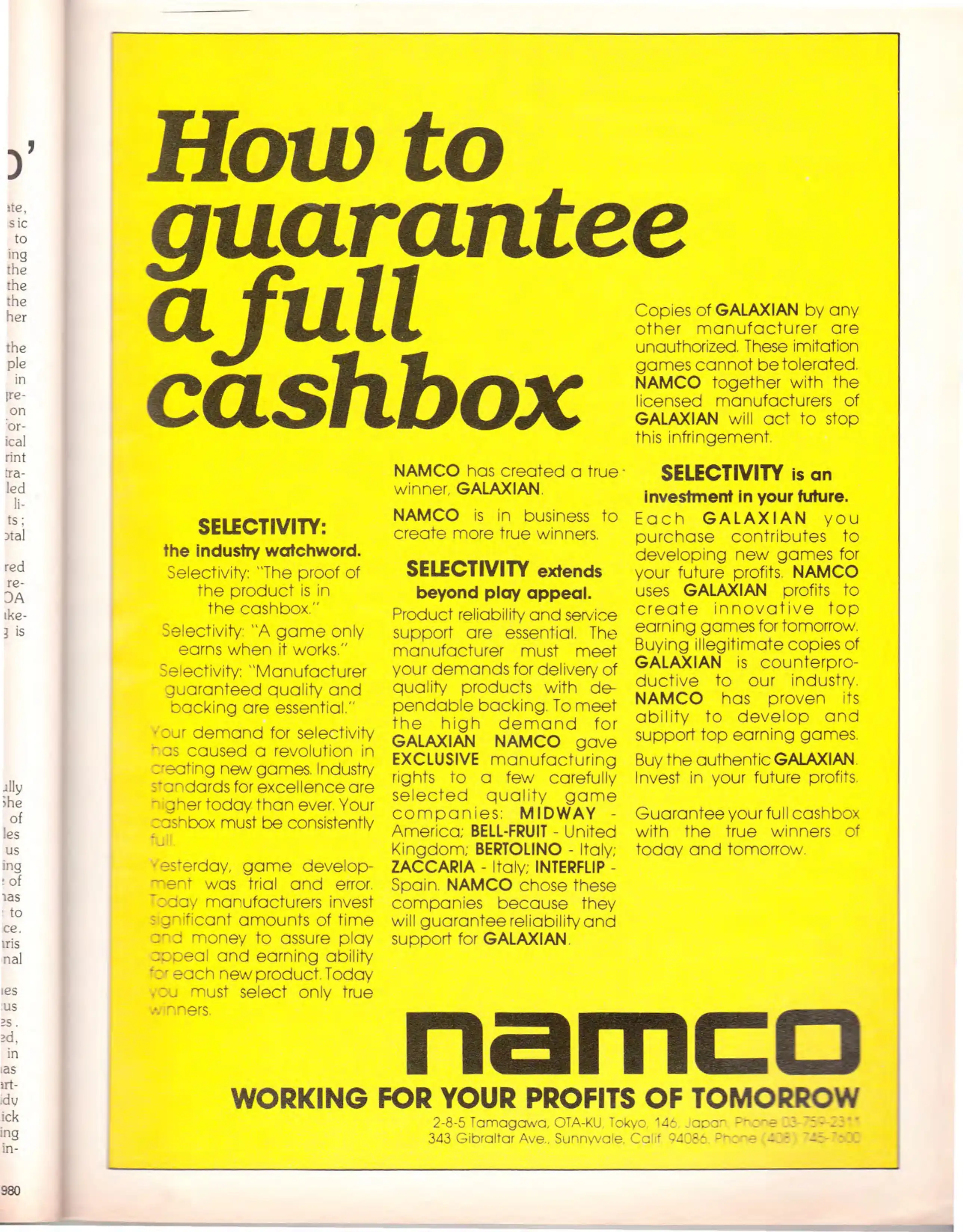
Radar Scope was released in October 1980, a full year after Galaxian. That’s plenty of time to reverse-engineer Galaxian, upgrade the sprite system from 8 to 128 sprites, and lift a few utility routines from its disassembled ROM.
This theory fits the evidence best: it explains the matching sprite record, and it explains why Donkey Kong shares only
small, self-contained routines instead of whole subsystems. Copied routines would also explain why Donkey Kong’s
RST $08 checks a different flag at the same RAM offset.[18]
No inside access was needed: by the end of 1979, production boards were already in arcades. Namco did lose a Galaxian cabinet during a location test – business manager Katsutoshi Endo recalls it vanishing the same day it was installed, and president Masaya Nakamura saying, “If it’s good enough to get stolen, it’ll be a hit” – but nothing connects that theft to Ikegami.[19]
Radar Scope wasn’t a clone of Galaxian, it had novel features. It had a pseudo-3D perspective, a pulsating frontline of enemies, and a leaderboard where Galaxian has only a single high score.[20]
The Goroawase Angle#
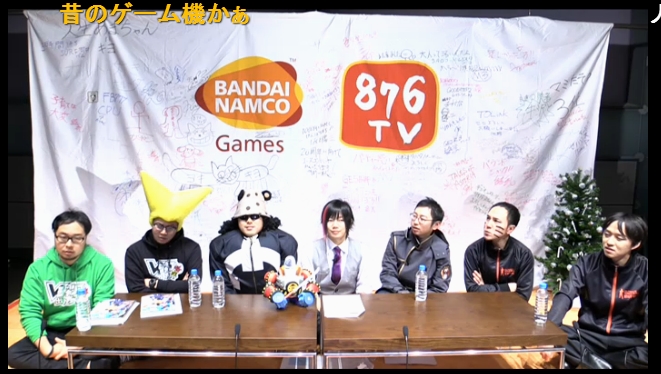
Bandai Namco’s own 876TV channel. Note the banana hat.#
There may be another clue, which involves a concept called goroawase (語呂合わせ). This is a common form of Japanese wordplay whereby homophonous words are associated with a given series of letters, numbers or symbols. This is often used as a memorization technique, for example the number 1492 can be memorized as: “i (1) yo (4) ku (9) ni (2)” meaning: “Wow! I can see land!”[21]
In Donkey Kong, the default high score is 7650. 765 stands for “na-mu-ko” or Namco. Derivatives of this number can be found in dozens of Namco-produced video games. (After Namco merged with Bandai, the goroawase number became 876, “ba-na-mu”.)
This one needs caution. The other default entries in Donkey Kong’s table – 6100, 5950, 5050, 4300 – carry no message, and when you go looking for a hidden number in a game, you’ll usually find one. It would mean more if Radar Scope’s table also starts at 7650, or if Galaxian’s own defaults use 765.[22]
There’s one more nod to Namco: after Jumpman picks up a hammer, enemies in Donkey Kong turn blue and vulnerable for a short time, like the ghosts in Pac-Man. But Pac-Man was the biggest hit of 1980, and anyone could copy a game mechanic by playing it, so this doesn’t suggest any connection beyond imitation.[23]
What We Know#
Here’s where the evidence stands.
Documented: Nintendo engineers saw Galaxian, wanted sprites, and had Ikegami build Radar Scope to their spec. Donkey Kong reused Radar Scope’s board and parts of its code.
Verified in the ROMs: Galaxian and Donkey Kong share a handful of short routines byte for byte – the
RST $08early-out, theRST $28dispatcher, the score adder, the task-queue reader – and lay out sprite records the same way.Not known: how that code got from Namco’s ROM into Ikegami’s.
The simplest explanation is that Ikegami’s engineers studied a Galaxian board, as bootleggers across the industry did, and kept a few routines they liked. Testing that means looking for the same routines in Radar Scope and in Ikegami’s other work. If they turn up in anything Ikegami shipped before Galaxian, the borrowing may have gone the other way.
If you worked at Namco, Nintendo or Ikegami in 1979-81, or have a better theory, I’d love to hear from you.
References#
People#
Toru Iwatani (Pac-Man)
Koichi Tashiro (Galaxian programmer)
Shigeichi Ishimura (Galaxian h/w, Pac-Man board; Namco president/CEO 2005)
Shigeru Yokoyama (Cutie Q, Galaga)
Tetsu Ogawa (programmer, Galaga)
Akira Takundai (bosconian?)
Hurashi Nagumo (bosconian)
Shigeki Fujiwara (Crazy Climber)
Fact-check notes#
Draft only: grep for [fact-check and remove before publishing.
Draft notes#
[fact-check – link rot.] Dead as of 2026-08-23: wiki.donkeykonggenius.com (domain gone),
groundkontrol.com (404), arcadeclassics.net (404), usgamer.net (503, site defunct).
gamasutra.com now redirects to gamedeveloper.com – update the URL. Everything else responds
(some return 403/406/429 to bots but load fine in a browser). Worth adding archive.org copies of the four
dead ones.
Sources used in this fact-check that are not yet listed below:
Bandai Namco, “Untold Stories of the Creation of PAC-MAN” (Ishimura, Endo)
MAME source:
src/mame/galaxian/galaxian_v.cpp,src/mame/nintendo/dkong_v.cpp,src/mame/nintendo/dkong.cpp
[fact-check] Two corrections in this list. Ishimura is Shigeichi, not Shigekazu, and he is the one who ran mobile content from 1999 and became Namco president and CEO in 2005 – that detail is currently attached to Koichi Tashiro. Tashiro’s own post-Galaxian career still needs a source. Akira Takundai and Hurashi Nagumo remain unverified in any primary source.
[fact-check – images.] ikegami-hq.png is 10 MB; resize before publishing. Both ikegami-hq.png
and ishimura.png need provenance and attribution – the Ishimura portrait appears to come from Bandai
Namco’s interview page.
[fact-check – open action items.]
Publish the ROM scan. Partly done 2026-10-02:
romscan.pyand the table above cover Galaxian / DK / Scramble. Still needed: Radar Scope, Cutie Q, Congo Bongo, Zaxxon, Mario Bros ROMs, and a byte-level diff of the scoreboard routines. Also verified in dkdasm: DK’s default top score is 7650 ($3565); Radar Scope’s is still unchecked.Z80 sourcebook theory – partly tested 2026-10-02. Searched the OCR text of Zaks, “Programming the Z80” (Sybex, 2nd ed., 1980, archive.org): neither idiom is taught.
INC SPappears only in the instruction tables; there is no example that discards a return address. The only “branch tables” are relative-branch opcode tables, not jump tables; the subroutine chapter covers registers, memory and the stack for parameters, andJP (HL)appears only in the instruction reference. Web searches found no period source for either idiom. Also searched the OCR text of Zilog’s “Z80 Assembly Language Programming Manual” (April 1980, bitsavers/archive.org):INC SPappears only in the opcode table,POP HLandEX (SP),HLonly in the instruction reference, and the only “vector table” is the interrupt-mode-2 table. Its subroutine section warns that aRETwith an un-popped push on the stack goes to “a meaningless address” – it treats stack imbalance as a bug, not a technique. Not checked: Mostek application notes, and 1979-81 Z80 tricks books or magazine columns. So neither idiom is in the two main period references, which favors shared source over textbook origin, but both are known to be possible in the instruction set and absence from two books does not prove they were uncommon practice.Manufacturer correlation – partly supported. One secondary source (thehistoryofhowweplay.wordpress.com) says Namco, unable to meet demand, had Taito, Sega, Nichibutsu, Irem and Konami manufacture Galaxian boards; Wikipedia’s Galaxian article mentions licensing to Taito and Irem. That would put Galaxian boards (and plausibly ROMs) in the hands of the Konami and Taito matches, and fits Scramble running on Galaxian-derived hardware. Caveats: the source says nothing about code access, I found no primary source, and Nintendo and Ikegami are not on the list, so this does not explain DK. It also fits only partly: Scramble lacks the
RST $08routine. Next: confirm with Namco/Midway-era sources, and check whether the Wild Western / Front Line hits come from Taito-built Galaxian boards.Reconcile the title: the file is
namco-nintendo-connection.md, the heading is “The Galaxian-DK Connection.”Consider contacting a primary source – Komanome has written publicly, Sean Riddle is reachable, and GDRI’s maintainers track exactly this question. One confirmation on the code question would make the piece definitive.